

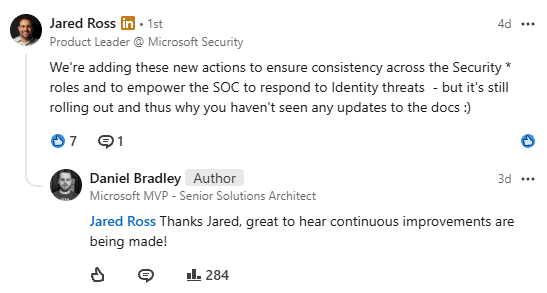
In the last few days, Microsoft just added 13 application permissions to Microsoft Graph for deleting authentication methods from user identities. They are not yet formally documented outside of this article, but my msgraphpermissions.com tracker picked them up early. These new scopes let an unattended application remove credentials without otherwise receiving permission to, create or modify them. It nicely ties in with Microsoft’s currently ongoing strategy to empower SOC teams to respond to Identity threats in Microsoft Entra, which I learned after a comment on a recent article I wrote about changes to the Security Administrator Entra role.
One core permission, UserAuthenticationMethod.Delete.All, covers authentication methods generally, but the other 12 restrict deletion to a particular authentication mehtod type:
UserAuthMethod-Email.Delete.AllUserAuthMethod-External.Delete.AllUserAuthMethod-HardwareOATH.Delete.AllUserAuthMethod-MicrosoftAuthApp.Delete.AllUserAuthMethod-Passkey.Delete.AllUserAuthMethod-Phone.Delete.AllUserAuthMethod-PlatformCred.Delete.AllUserAuthMethod-QR.Delete.AllUserAuthMethod-ResourceKey.Delete.AllUserAuthMethod-SoftwareOATH.Delete.AllUserAuthMethod-TAP.Delete.AllUserAuthMethod-WindowsHello.Delete.All
Every scope is app-only, requires administrator consent and applies across all users in the organisation.
The UserAuthenticationMethod.ReadWrite.All permission lets an application read and write every user’s authentication methods. However, an incident-response workflow that only removes a stolen passkey or an Authenticator registration should not also need permission to inspect and alter unrelated credentials.
Deletion remains a destructive action, and just deleting a method at the wrong time, may lead to a malicious actor registering their own authentication method (or doing it again). Microsoft says a user with no remaining methods will be prompted to register again when strong authentication is next required. Automation should then use a well though out recovery path, ensure it retains audit records and some level of protection against targeting the wrong identity.
Microsoft’s Identity documentation has not caught up. For example, the FIDO2 deletion API still lists UserAuthMethod-Passkey.ReadWrite.All as its least-privileged application permission, while the phone deletion API lists the broader UserAuthenticationMethod.ReadWrite.All. Microsoft has not yet classified the new permissions or mapped them to request samples.
I would not replace existing consent based on these new permissions alone just yet, although you can certainly start testing like I have. Wait for Microsoft to document support for it, the when support is confirmed, move recovery automation away from ReadWrite access wherever a deletion-only permission covers the job.

Microsoft let go of the folks who handled Identity docs. Hopefully engineers can update them.